China builds world’s first 10,000-car dual-fuel vehicle carrier
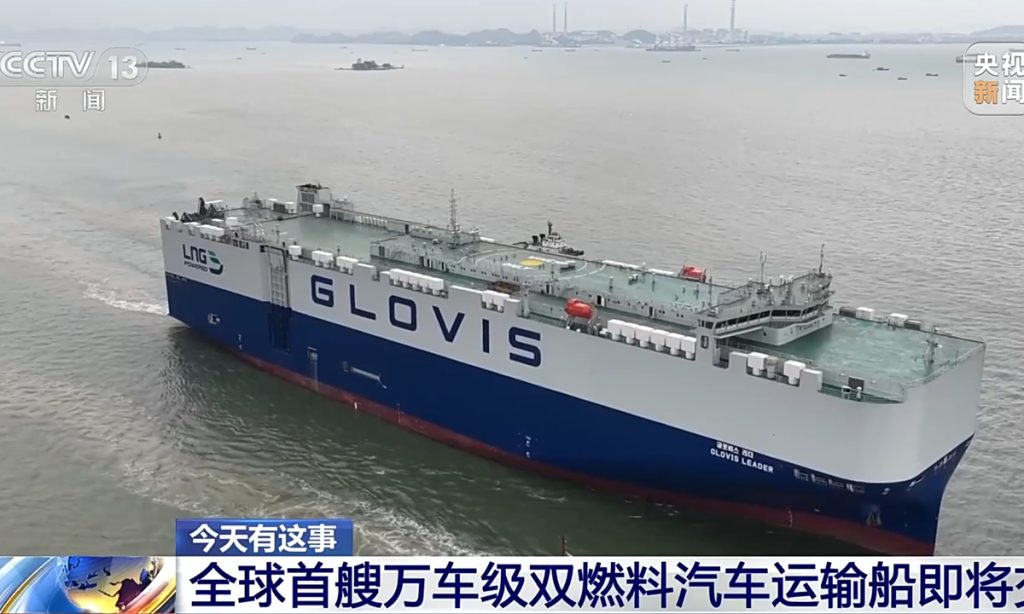
The world's first dual-fuel car carrier with a capacity exceeding 10,000 vehicles was delivered on Tuesday in Nansha district in the southern city of Guangzhou, capital of Guangdong Province, the CCTV News reported.
The delivery of the vehicle carrier marks that China has fully mastered the construction technology for this type of vessel, maintaining a leading position in this specialized segment of the global market, said the report. It was built by Guangzhou Shipyard International Co under China State Shipbuilding Co.
The vessel measures 230 meters in length and 40 meters in beam, and features 14 vehicle decks. It is designed to flexibly transport a wide range of vehicles, including electric cars, hydrogen-powered vehicles, and heavy trucks, with a maximum capacity of 10,800 units, according to the report. The ship is also equipped with the latest green fuel system, meeting the newest global environmental standards.
The successful delivery of this new large dual-fuel car carrier reflects China's continued breakthroughs in high-end shipbuilding system integration and green shipping technology, and shows that the relevant industrial chain has developed strong independent innovation capabilities and a highly systematized manufacturing capacity, Lin Boqiang, director of the China Center for Energy Economics Research at Xiamen University, told the Global Times on Tuesday.
From an industry perspective, Lin said that the deployment of such vessels can help improve both the efficiency and environmental performance of global automobile maritime transport, while also strengthening the technological position of Chinese shipbuilders in the international high-end market.
Lin added that this is not merely progress in a single product, but rather a sign that China is gradually building a stable competitive edge in new-energy-driven maritime equipment, offering practical solutions for the green transformation of the global shipping industry particularly against the backdrop of rising global energy tensions.